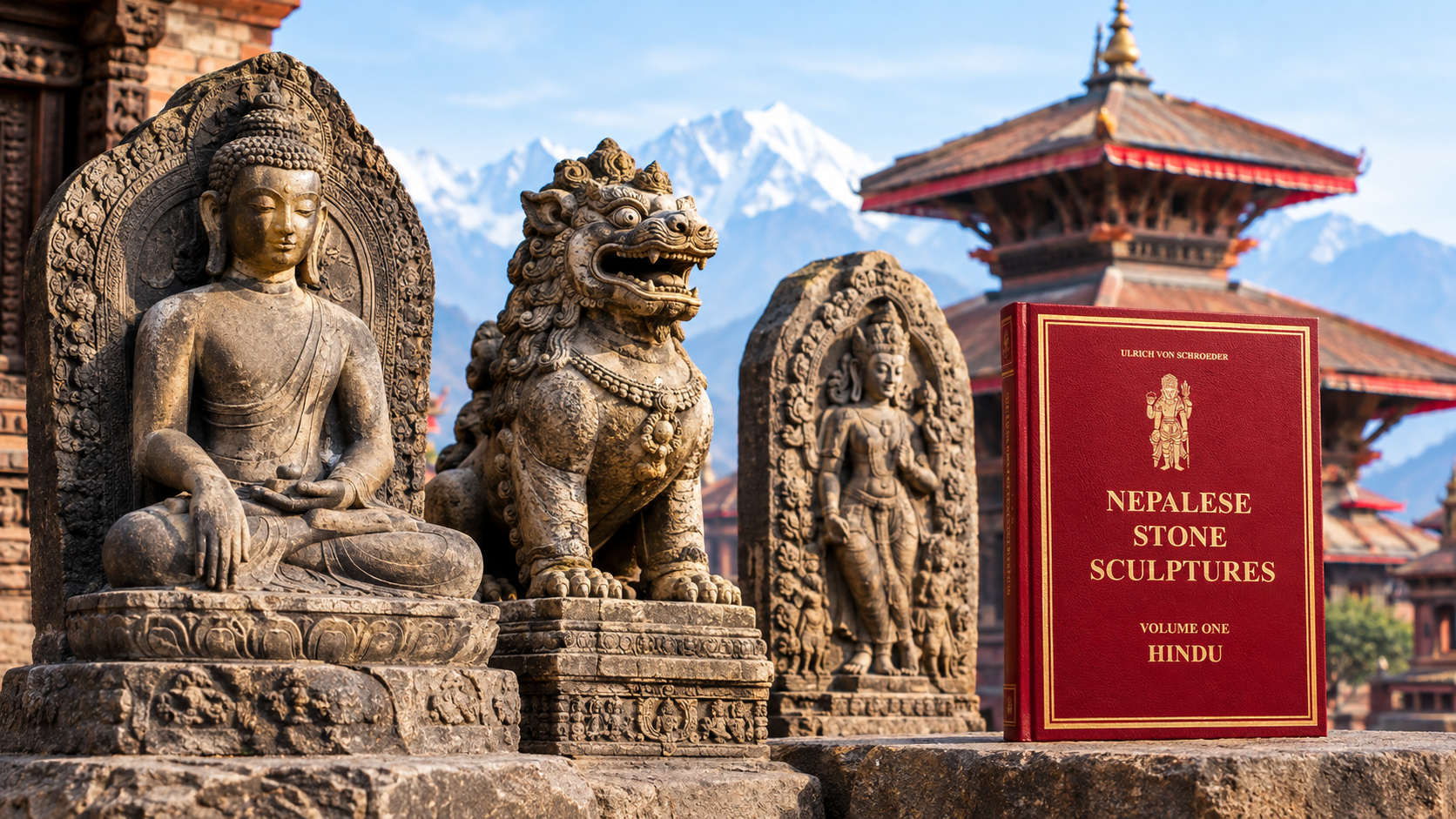
Nepalese Art and Stone Sculptures of the Kathmandu Valley
Walk through the older parts of the Kathmandu Valley, and you will find sculpture almost everywhere. Figures sit in temple courtyards and beside shrine entrances. Others stand in monastery compounds or on stone platforms worn smooth by generations of visitors. Some are monumental. Some are small enough that you would walk past them if nobody pointed them out.
They belong to a long tradition of Nepalese art, one where belief, craft, and daily life never drifted far apart. Nepalese stone sculptures are among its best surviving pieces of evidence, and they tell us a good deal about how art developed in the valley and beyond.
Stone Sculpture in the Kathmandu Valley
Stone carving in Nepal goes back a long way, but the Kathmandu Valley became its main center. Its temples and shrines kept calling for new images: Hindu and Buddhist deities, guardian figures, and other sacred subjects.
Few of these sculptures were made to be admired on their own. Setting mattered. An image might be commissioned for one particular shrine, fitted into an architectural scheme or tied to a specific ritual. Its posture, its attributes, and the figures around it all fed into what it meant.
The material mattered too. Carving stone is a different job from casting bronze or modelling clay. Folds of clothing, jewellery, and faces must be planned around what the stone will allow. The finest sculptors make that difficulty disappear. Their figures look composed, almost easy, even when the ornament is dense.
Hindu and Buddhist Imagery in Nepalese Art
One notable feature of Nepalese art is that Hindu and Buddhist traditions shared the same cultural landscape. The two were distinct, but the artistic world around them was not neatly divided.
Stone images of Shiva, Vishnu, Devi, and other Hindu deities stood alongside Buddhas, bodhisattvas, and Buddhist protective figures. For anyone studying them, naming the subject is only the first step.
The details do the real work. A hand gesture can mark out a Buddha or a bodhisattva. A weapon, a vehicle, a crown, or a ritual object may be what separates one deity from another. Even the way figures are grouped around a central image can hint at what the sculpture was meant to say.
So studying Nepalese stone sculptures takes more than an eye for good carving. You need iconography, religious texts, stylistic comparison, and some sense of where the work originally stood.
A Tradition Shaped by Exchange
The Kathmandu Valley was never cut off. It lay between the Indian subcontinent and the Himalayan region, and artists, patrons, religious ideas, and techniques all passed through it.
India shaped Nepalese sculpture in major ways. Later, the valley’s own traditions became hugely important in Tibet. Newar artists made religious images for Tibetan patrons, and Nepalese conventions ended up as part of the visual language of Tibetan Buddhist art.
Influence ran both ways, though. Local artists adapted what they received to their own materials, workshops, and religious settings. That is why Nepalese sculpture cannot be written off as a branch of Indian or Tibetan art. It has a recognisable character of its own.
Looking closely at individual pieces helps. The treatment of jewellery, the proportions of a body, the modelling of a face, and the design of a lotus pedestal: any of these can show how works from different regions and periods are related.
Why Photographic Documentation Matters
Access is a large part of the challenge in studying Himalayan sculpture. Historic works turn up in religious institutions, public spaces, and private collections, and some of those places are not easy for a researcher to reach. Some pieces have also been moved from where they began.
Good photographs help a great deal. A scholar can study an object again and again, compare it with related sculptures, and spot details that a short visit would miss.
There is a longer-term benefit too. Sculptures get damaged, restored, or relocated, or simply become harder to see. Once a work has been photographed and recorded, with notes on its subject, style, and location, it joins a much larger body of research.
Ulrich von Schroeder’s Record of Nepalese Stone Sculptures
One of the substantial reference works in this field is Ulrich von Schroeder’s Nepalese Stone Sculptures, published by Visual Dharma Publications.
The study runs to two volumes and documents approximately 2,900 sculptures. Volume one deals with Hindu sculpture. Volume two focuses mainly on Buddhist sculpture. Together they give a broad visual record, and they let you set works from different periods and traditions next to each other.
That comparison is where the book earns its keep. A sculpture can look odd on its own. Put it beside related examples and similarities that start to show in how a deity is treated, how an ornament is designed, or how a figure is proportioned.
For researchers of Himalayan art, a work like this does more than illustrate. It gathers objects that are otherwise scattered across temples, collections, and countries, and that makes wider stylistic and historical comparisons possible.
Reading Nepalese Art Through Its Sculpture
Stone sculpture is one of the clearest ways into the history of Nepalese art, because so much can be read from the objects themselves. The subject points to religious practice. The carving shows the skill and habits of a workshop. Iconographic details identify the figure, and style can suggest a period or a particular artistic setting.
The sculptures also say something bigger about where the Kathmandu Valley sat in Asia. Ideas moved across the region, artists worked for patrons outside their own communities, and traditions changed as they met new influences.
That is why Nepalese stone sculptures deserve to be studied as historical documents and not only as devotional images or fine craftsmanship. They hold evidence of artistic practice, religious life, and cultural exchange that written sources cannot always supply.
Continue Exploring Nepalese and Himalayan Art
Readers who want the wider story of Himalayan sculpture can look at other titles from Visual Dharma Publications, a scholarly publisher of Buddhist art books since 1981:
- Buddhist Sculptures in Tibet
- Indo-Tibetan Bronzes
- The Tenth Karmapa: Tibet’s Greatest Artist
- Browse the full catalogue
Order or Enquire
For a closer study of Nepalese Stone Sculptures offers a substantial photographic and scholarly record. To order it or any other title, contact Visual Dharma Publications